When 23 Navigation Findings Become One Claim File
By Captain Georgios Giannakouris · 26 May 2026 · 6 min read
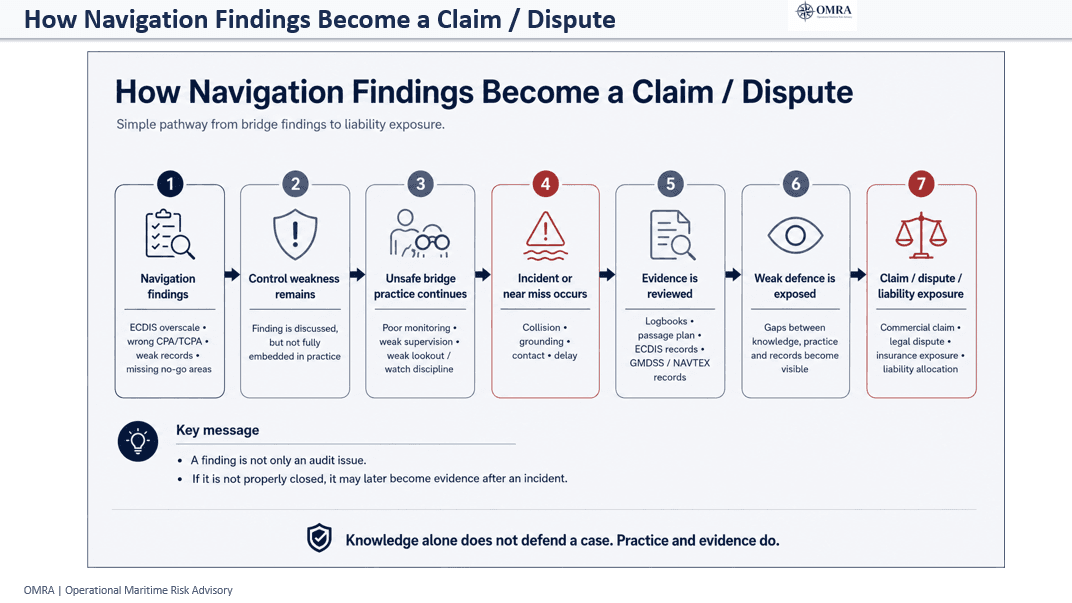
A navigation finding is not always just an audit finding.
Sometimes it is the first page of a future claim file.
Before an incident, a wrong setting, a missing entry or an incomplete passage plan may look like a small operational gap. After an incident, the same item becomes evidence.
The real issue is not always knowledge
In many cases, bridge officers can explain the procedure correctly. They may know the COLREGs, they may know ECDIS, they may understand UKC, CPA/TCPA, NAVTEX, GMDSS and passage planning requirements.
But in a dispute, the question is not only what the bridge team knew. The question is whether the knowledge was applied, recorded and verified at the time.
This is where many operators become exposed. The bridge team may have the knowledge, but the records may tell a different story.
How ordinary findings can become dispute evidence
Wrong CPA/TCPA setting. If a close-quarters situation or collision occurs, the radar settings will be reviewed. A wrong CPA/TCPA setting may be used to question whether the OOW had enough warning time and whether company procedures were followed.
ECDIS in overscale. If grounding, deviation from track or unsafe monitoring is alleged, ECDIS scale use becomes important. Overscale may suggest that the OOW was not using the best available chart scale for safe monitoring.
Passage plan not properly verified. Missing actual waypoint passing times, incomplete no-go areas or waypoints not entered in both GPS units may be used to argue that the passage plan was not actively monitored.
Generic night orders. If an incident happens during the night, generic bridge orders may weaken the Master's defence. The question will be whether clear, voyage-specific instructions were given for the actual navigational risk.
SNA requirements not properly evidenced. When a vessel passes a sensitive or high-risk navigation area, the evidence must show that the required bridge watch condition, engine readiness and additional precautions were implemented.
NAVTEX / EGC warnings not properly handled. Unread or poorly filed navigational warnings can become serious after an incident. The issue will be whether warnings were received, reviewed, understood and acted upon.
GMDSS log and training gaps. Missing GMDSS entries or distress message training evidence may not cause an incident, but they can damage the credibility of emergency preparedness.
Missing anchoring verification. If dragging anchor, contact, delay or off-hire is alleged, incomplete anchoring records and missing Master verification will be closely examined.
Bridge manning and lookout gaps. If a collision or near miss occurs, bridge manning and lookout arrangements are among the first items reviewed. A known requirement not properly implemented becomes difficult to defend.
Celestial observation and position verification gaps. When company procedures require independent position verification, missing evidence may create the impression of over-reliance on electronic navigation, even where the officers are capable.
What a claimant will normally look for
After a casualty or commercial dispute, the review does not stop at the immediate event. The review usually goes backwards.
The documents, logbooks, ECDIS records, passage plan, night orders, GMDSS log, NAVTEX records, radar settings, watch condition and Master's supervision will all be compared against the company SMS and good seamanship practice.
If the records are weak, the argument becomes simple: the ship may have had procedures, but the procedures were not effectively implemented.
In claims and disputes, knowledge without evidence is weak. Evidence without proper practice is also weak. The strongest position is when practice, records and supervision all tell the same story.
The legal risk is the gap between procedure and practice
Most companies have good procedures. The problem appears when the ship cannot prove that the procedures were followed in real time.
A checklist completed without supporting evidence may not be enough. A bridge order signed by officers may not be enough. A passage plan approved ashore may not be enough. The real question is whether the bridge team used these controls during the navigation.
That gap between written procedure and actual practice is where claims, disputes and expert investigations often focus.
Practical lesson for Masters and operators
Navigation audits should not be treated as paperwork inspections. They should test real bridge behaviour.
The Master should verify not only that forms exist, but that they reflect what is actually happening on the bridge.
Officers should not only know how to answer questions during an audit. They should be able to show that safe navigation practices are applied during the watch and properly recorded.
Small findings are best closed before the casualty. After the casualty, they may become part of the claim narrative.
OMRA view
From an operational point of view, these findings are training needs.
From a claims and dispute point of view, they are potential exposure.
The purpose is not to blame the bridge team. The purpose is to close the gap before an incident turns a manageable finding into a commercial dispute.
A navigation audit is useful only when it tests what is really happening on the bridge. Because after an incident, the evidence will be tested much harder than the checklist.