Why Operational Evidence Matters in Maritime Claims and Disputes
By Captain Georgios Giannakouris · 13 June 2026 · 8 min read
Most maritime disputes are not decided by what actually happened on board. They are decided by what can be proven about what happened on board. Those are not the same thing.
A vessel may have been operated competently. The Master may have made a reasonable decision in the circumstances known at the time. The crew may have followed the procedure. None of that helps if the records cannot demonstrate it later, to people who were never on board and who arrive months after the event with a contrary narrative already prepared.
This is the central point I want to make, and it is the foundation of how OMRA approaches operational evidence. The strength of a company's position in a claim depends on what can be proven. And evidence is not produced after the claim arrives. It is produced during the operation, in the ordinary records made while the work is being done.
What operational evidence actually is
When lawyers and surveyors talk about evidence, the word can sound abstract. On board it is concrete and familiar. Operational evidence is the trail of contemporaneous records that a working ship generates as a matter of routine.
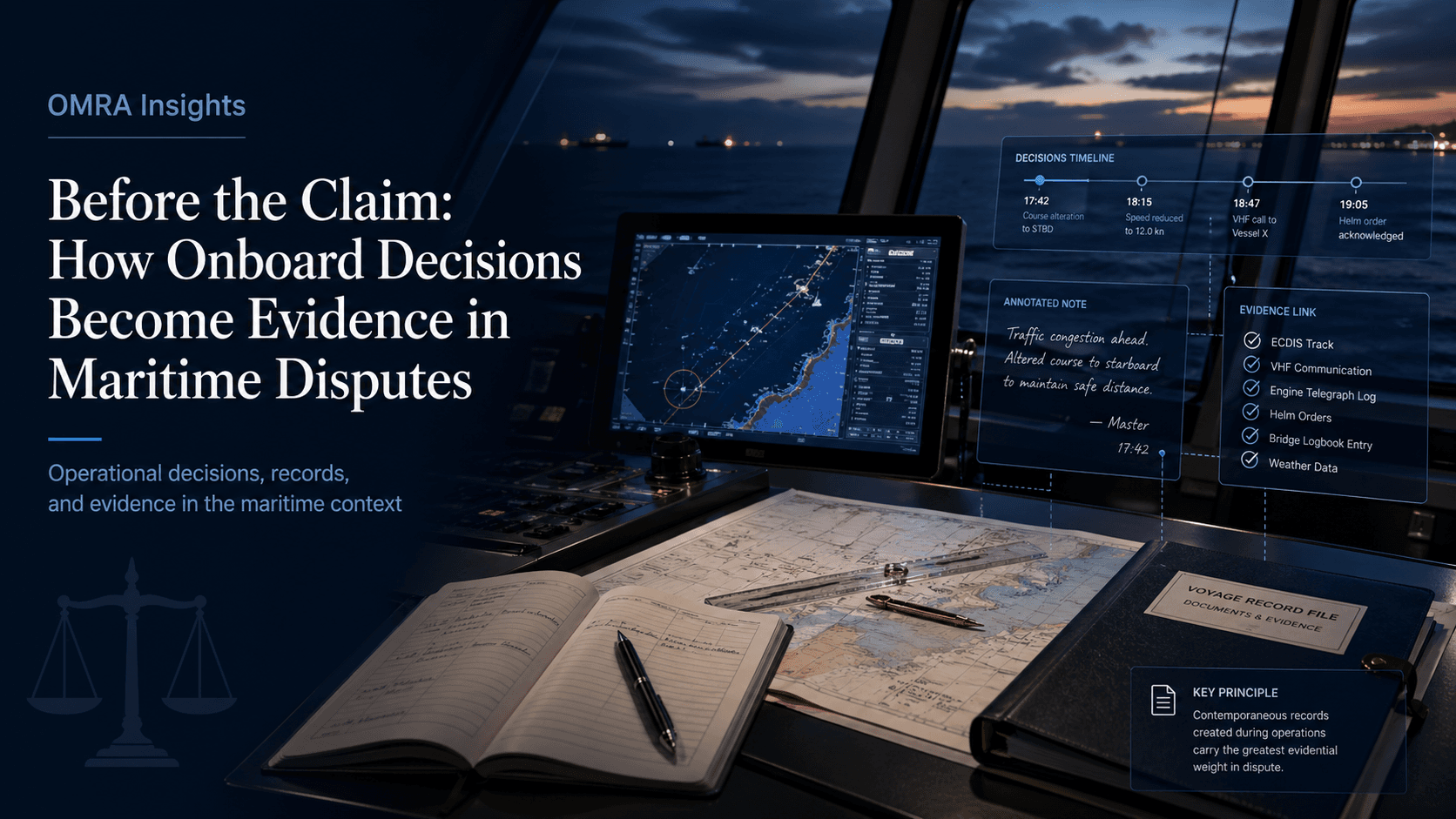
It includes the deck and engine logbooks, the bridge records, ECDIS data and route history, VDR data, radar information, and alarm and engine movement records. It includes passage plans, risk assessments, permits to work, gas readings, atmosphere logs, and the toolbox talks held before a hazardous job. It includes certificates, calibration and bump-test records for the instruments relied upon, photographs and video, handover notes, and the decision records and communications exchanged between vessel and shore.
These are not legal documents. They are operational documents. But once an incident becomes a claim, they are read as evidence, and they are read closely.
A reasonable decision is not the same as a defensible one
Here is the difficulty that catches many good operators. A decision can be entirely reasonable and still be hard to defend, because the record does not show why it was reasonable.
Consider a course alteration made to avoid a developing traffic situation. Operationally it is sound seamanship. But if the only entry reads "course altered due traffic", the record does not show what the traffic situation was, what the risk was, or why that particular action was chosen. In a dispute, that gap is where the opposing party works. The decision was good. The proof of it is thin.
I return often to three questions, because they are the questions a contemporaneous record needs to answer for any important decision: what was the situation, what was the risk, and why was this action taken. When those three elements are present, a reasonable decision is also a defensible one. When they are missing, the decision stands alone, unsupported, and exposed to hindsight.
The qualities that make evidence defensible
Not all records carry the same weight. From the perspective of the people who later examine the file, defensible evidence has a recognisable set of qualities.
- Complete. The important matters are recorded, not only the routine ones. Silence on a critical point is itself read as a finding.
- Consistent. The documents agree with each other. The permit, the gas readings, the logbook and the photographs tell one coherent story, not several.
- Traceable. It is clear who recorded what, when, and on the basis of which instrument or observation. A reading without a source, a signature, or a time is weak.
- Contemporaneous. It was made at or near the time of the event, not reconstructed afterwards. Records made while memories are fresh are treated as more reliable than later explanation.
- Understandable to an outsider. An independent reviewer who was never on board can follow the record and reconstruct the event without relying on someone's verbal account. This is the real test, and it is the one most often failed.
These qualities are not a matter of producing more paper. A heavier file of generic entries is weaker, not stronger. The point is whether the record preserves the truth of the operational decision in a form that survives later scrutiny.
How evidence fails
In my advisory work the failures repeat, and they are worth naming plainly so they can be recognised on board before they matter.
The first is the gap. A critical matter was simply not recorded. The event may well have happened, but the absence of a record creates room for challenge, and in a contested claim that room is exploited.
The second is silence where a decision was made. Overriding authority exercised but not documented. A risk identified and acted upon, but never written down. The action is invisible, so it cannot be defended.
The third is boilerplate. Generic phrases such as "all safety precautions taken", "risk assessed", or "equipment checked and found satisfactory" look compliant and prove almost nothing. They satisfy a routine, but they collapse the moment a case requires specific technical explanation.
The fourth is reconstruction after the fact. Records assembled once a claim is anticipated rarely carry the weight of contemporaneous ones, and the difference is usually visible to an experienced reviewer.
The fifth, and often the most damaging, is internal inconsistency. A permit that states the atmosphere was tested, sitting next to gas readings that were never taken. A logbook that contradicts the ECDIS track. A checklist marked complete that the photographs do not support. When the documents disagree with each other, the weakest one is not the only casualty. The credibility of the whole file is questioned.
Who reads this evidence, and how
It helps to remember that operational records are eventually read by people with a very different purpose from the crew who created them.
Surveyors examine the physical and documentary record to establish what occurred. P&I Clubs and insurers assess exposure and the defensibility of the position. Lawyers build or test the case. Arbitrators and tribunals, who were not present and were not on board, decide disputed facts on the basis of what can be proven. Expert witnesses assess whether the actions were reasonable in the circumstances known at the time, and they can only go as far as the evidence allows. Investigators reconstruct the sequence of events.
None of these readers were there. Every one of them depends entirely on the record. Where the evidence is complete and consistent, they can reach clear conclusions. Where it is incomplete or contradictory, they are forced to qualify, to challenge, or to infer, and inference rarely runs in favour of the party whose records are silent.
How OMRA approaches operational evidence
OMRA treats this as a single discipline with two sides, one human and one built into the VARINTA platform.
The advisory side is Core Service VII, Operational Evidence Screening and Defensibility Review. It is an independent review of whether a company's records are complete, consistent, traceable and defensible, carried out before they are tested in a dispute, claim, casualty, fatality, investigation, P&I matter or legal review. The principle is simple: it is far better to find the weakness in your own evidence while it can still be corrected and understood, than to have an opposing party find it for you. The review reads the records the way a surveyor, an arbitrator or an expert later will, and reports where the file is strong and where it is exposed.
I want to be exact about what this is and is not, because the positioning is deliberate. This is independent maritime advisory. It is not an audit, and it is not legal advice. It does not certify compliance and it does not replace your lawyers or your Club. It is an experienced operational and command-level assessment of whether your evidence will hold.
The built side is the evidence ledger inside the SafeOps module of the VARINTA platform. Safety records, gas readings, certificates and the structured evidence pack are captured at the time and stored in a form an independent reviewer can later understand. The ledger is append-only by design: records are added and read, never edited or deleted, and a record can be marked as withdrawn but it stays visible. That permanence is the point. Evidence that can be quietly altered after the fact is not evidence at all. The module also runs a first automated consistency check, screening issued permits against their gas readings, which is precisely the kind of internal contradiction that does the most damage in a dispute. The deeper review of generic records and the final defensibility judgement remain the work of an experienced consultant, supported by the evidence pack rather than replaced by a score.
Practical principles for Masters and operators
A few principles, drawn from command experience and from reviewing files after the fact, reduce evidential weakness without turning the bridge into an office.
- Record important decisions at the time, not in reconstruction afterwards.
- Record the reason for the decision, not only the action taken. Situation, risk, reason.
- Avoid generic remarks where the situation calls for specific explanation.
- Keep the documents consistent. A permit, its gas readings and the logbook must agree.
- Preserve electronic evidence immediately after an incident, before data is overwritten.
- Date photographs, make them relevant, and support them with written context.
- Ensure every reading and signature is traceable to a person, an instrument and a time.
- Document overriding authority whenever it is exercised.
- Treat the file as something an outsider must be able to read and understand on its own.
None of this asks a Master to predict the legal arguments that may one day arise. It asks only that the record of a sound decision be as sound as the decision itself.
Final OMRA observation
Operational evidence is not paperwork produced for its own sake, and it is not a defensive exercise begun after something goes wrong. It is the contemporaneous record of how the ship was actually run, and it is created in the ordinary course of operating safely.
In a claim, that record does the talking. A strong operational decision deserves a record strong enough to prove it. Without one, even a reasonable decision can become difficult to defend, and a difficult decision becomes indefensible.
The work, then, is not to write evidence after the claim. It is to make sure the records created during the operation will hold when they are finally read by people who were never there. At OMRA, that is the question we examine, before a dispute examines it for you.