Before the Claim: How Onboard Decisions Become Evidence in Maritime Disputes
By Captain Georgios Giannakouris · 27 April 2026 · 12 min read
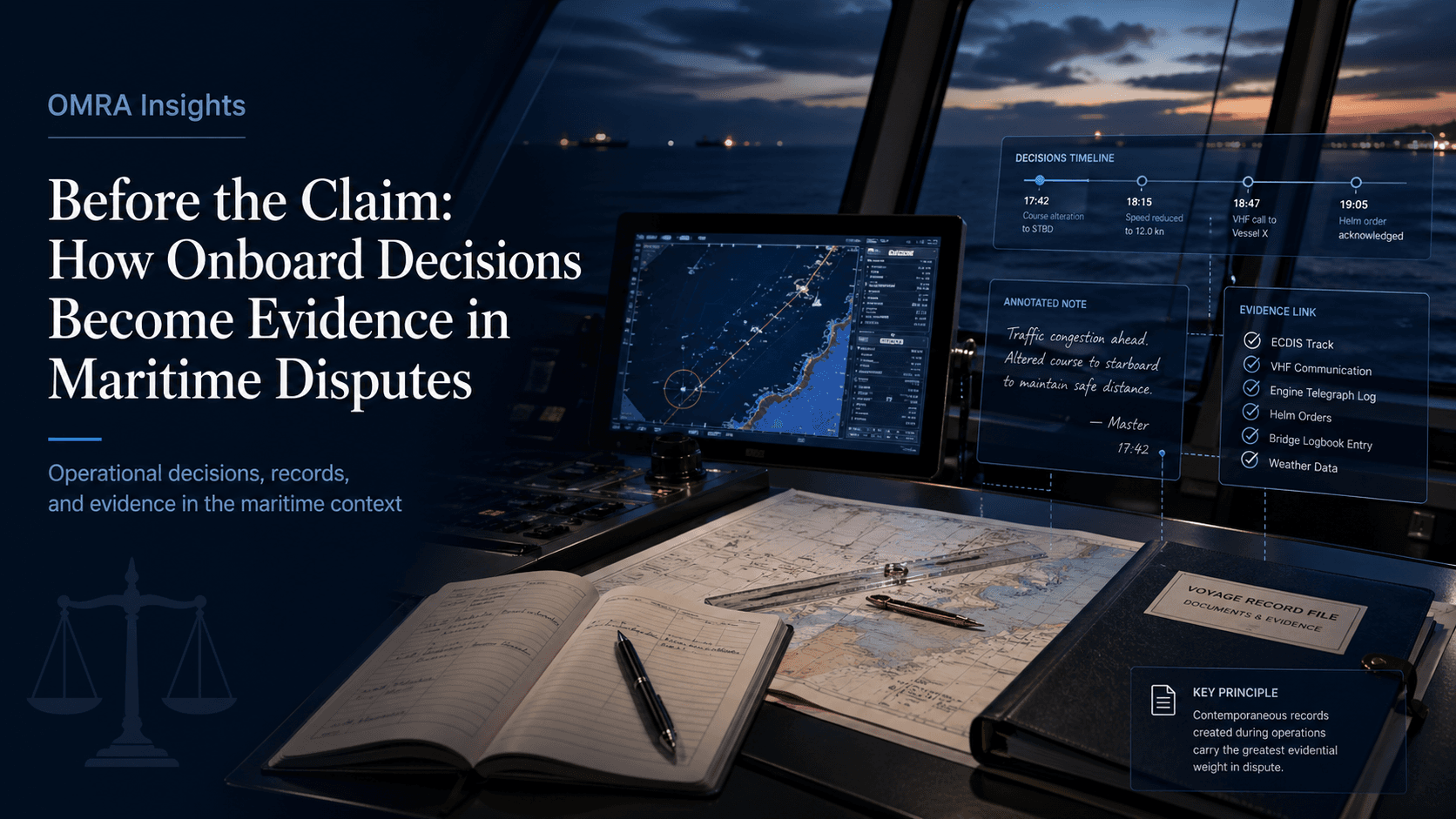
Operational decisions, records, and evidence in the maritime context.
Maritime disputes rarely begin when a claim is formally presented. In many cases, the foundations of the dispute are created much earlier, during the voyage itself, through decisions taken on board, communications exchanged between vessel and shore, records entered in the logbook, or records that should have been made but were not.
From an operational perspective, a Master or officer may consider a decision as part of ordinary shipboard management. From a legal, arbitral, or claims perspective, however, the same decision may later become a central evidential issue. A course alteration, a speed reduction, a deviation, a delay in reporting, a risk assessment, a permit to work, an ECDIS record, a logbook entry, or an email to the company may later be examined in detail by lawyers, insurers, P&I Clubs, surveyors, arbitrators, or expert witnesses.
The practical reality is simple: once an incident develops into a claim, the quality of the evidence often becomes as important as the technical facts themselves.
The operational moment and the evidential moment are not the same
On board a vessel, decisions are normally made under operational pressure. The Master may be dealing with traffic, weather, pilotage, port instructions, machinery limitations, cargo requirements, charterers' orders, commercial pressure, or instructions from shore management.
At that moment, the priority is safe operation.
However, once a dispute arises, the same situation is reviewed differently. The focus shifts from immediate operational control to retrospective analysis. The questions become more precise:
- Was the decision reasonable?
- Was it consistent with good seamanship?
- Was it supported by the circumstances known at the time?
- Was it properly recorded?
- Was the risk assessed?
- Were alternatives considered?
- Was the company informed?
- Were the Master's actions consistent with the SMS, charter party obligations, international regulations, and ordinary standards of prudent navigation or operation?
This is where many maritime cases become vulnerable. The Master may have acted reasonably, but the records may not clearly demonstrate why the decision was made. In that situation, a technically defensible decision may become difficult to prove.
Contemporaneous records carry particular evidential weight
In maritime claims and arbitration, contemporaneous records are often highly significant. Records made at or near the time of the event are usually more reliable than explanations prepared days, weeks, or months later.
A well-kept logbook, a properly completed passage plan, a signed risk assessment, a VDR extract, ECDIS data, cargo records, engine movement records, photographs, emails, permits, statements, and inspection checklists may collectively form the factual backbone of the case.
By contrast, weak or generic records create uncertainty. Where there is uncertainty, opposing parties may attempt to construct a narrative that is unfavourable to the vessel, the Master, the owner, or the manager.
For example, a logbook entry stating only "course altered due traffic" may be operationally understandable, but evidentially weak. A stronger record would identify the relevant traffic situation, the reason for the alteration, the risk considered, the action taken, the time, and any relevant communication.
The purpose is not to create defensive paperwork. The purpose is to preserve the truth of the operational decision in a form that can later be understood by persons who were not present on the bridge, in the engine room, on deck, or in the cargo control room.
The Master's decision must be capable of later explanation
A Master is not expected to predict every legal argument that may later arise. However, the Master's decisions should be capable of clear explanation.
In practical terms, this means that important decisions should answer three basic questions:
- What was the situation?
- What was the risk?
- Why was this decision taken?
If those three elements are missing, the record may not support the decision sufficiently. This is particularly important in cases involving deviation, unsafe port allegations, grounding, collision avoidance, cargo damage, speed and performance claims, bunker disputes, pollution incidents, pilotage events, machinery failures, port delays, and weather-related decisions.
In arbitration or expert review, the issue is not only whether something happened. The issue is often whether the decision was reasonable in the circumstances known at the time. That distinction is critical.
A decision must not be judged only with hindsight. However, in order to resist hindsight criticism, the contemporaneous evidence must show what was known, what was assessed, and why the selected action was considered appropriate.
Silence in the records may become an argument
One of the most dangerous evidential weaknesses is silence.
If a critical operational matter was not recorded, the absence of record may later be interpreted against the party relying on that fact. This does not necessarily mean that the event did not happen. But in a dispute, the absence of evidence creates room for challenge.
Examples include:
- A Master states that weather conditions were severe, but no detailed weather entries, photographs, Navtex warnings, forecast copies, or deck observations were preserved.
- A vessel claims that a port instruction caused delay, but the relevant VHF communication, email, or agent's instruction was not retained.
- A bridge team states that a dangerous traffic situation required a course alteration, but the ECDIS track, radar information, VDR data, and logbook entry are incomplete.
- A cargo damage defence relies on proper hatch cover inspection, but the inspection records are generic, unsigned, incomplete, or unsupported by photographs.
- A pollution prevention defence relies on readiness of spill equipment, but the checklist was completed as routine paperwork and the actual condition on deck does not support it.
In each case, the operational facts may be genuine. The problem is that the evidence may not be strong enough to prove them.
Generic records are not neutral records
A common weakness in shipboard documentation is the use of generic remarks. These records may appear compliant at first glance, but they often provide little value when examined in a dispute.
Phrases such as "all safety precautions taken," "risk assessed," "as per company procedure," "weather monitored," "traffic observed," or "equipment checked and found satisfactory" may not be sufficient if the case later requires detailed technical explanation.
A professional record should be specific to the actual situation:
- If a risk was assessed, the record should identify the relevant risk.
- If weather was monitored, the record should identify the source and significance of the weather information.
- If a route was amended, the record should explain the navigational reason.
- If a permit was issued, the record should demonstrate that the permit reflected the actual condition of the space, equipment, atmosphere, and surrounding risks.
- If a Master exercised overriding authority, the record should explain why the decision was necessary for safety.
Generic records may satisfy routine administration, but they rarely provide strong evidential support in a contested claim.
Evidence should be preserved before the narrative is lost
In many cases, the most valuable evidence is available immediately after the event, but may be lost if not preserved quickly.
This includes:
- VDR data.
- ECDIS screenshots and route history.
- Radar information where available.
- Bridge logbook entries.
- Engine movement records.
- Alarm records.
- Deck log entries.
- Cargo operation records.
- Photographs and videos.
- Permit to work documentation.
- Risk assessments.
- Weather reports and warnings.
- Email instructions.
- Pilot cards and Master/Pilot exchange records.
- Statements from involved personnel.
- Relevant company communications.
The first hours after an incident are critical. A vessel may continue operations, crew may change, electronic data may be overwritten, memories may fade, and documents may later be reconstructed. Once that happens, the evidential value of the material may be reduced.
For this reason, evidence preservation should be treated as an operational discipline, not merely as a legal reaction.
The expert witness perspective
From an expert witness perspective, the strongest cases are usually those where the operational record allows the expert to reconstruct the sequence of events objectively.
An expert should not be asked merely to support a preferred narrative. The expert's role is to assess the available material, apply professional experience, evaluate whether the actions were reasonable, and explain the technical or operational issues in a structured and independent manner.
- Where the evidence is complete, the expert can provide a clearer opinion.
- Where the evidence is incomplete, the expert must identify limitations.
- Where the evidence is contradictory, the expert must examine why.
- Where the records are generic, the expert may be unable to support important operational conclusions with sufficient confidence.
This is why evidence quality is not only a legal concern. It is also an operational risk management issue.
The arbitration perspective
In arbitration, the tribunal is often required to determine disputed facts based on documents, witness evidence, expert evidence, and contractual obligations. The tribunal was not present on board. It will rely on what can be proven.
A party that presents clear contemporaneous records, consistent witness accounts, structured expert analysis, and a coherent operational timeline is usually in a stronger position than a party relying mainly on later explanations.
This does not mean that every onboard decision must be written like a legal submission. Ships must operate efficiently. However, critical decisions should be recorded with enough clarity to allow later verification.
In practical terms, good records help answer the questions that arbitrators, lawyers, P&I Clubs, and experts will later ask.
The role of shore management
The responsibility does not rest only with the Master. Shore management plays an important role in creating a culture where accurate recording, early reporting, and evidence preservation are understood as part of safe operation.
Companies should not encourage excessive paperwork without purpose. However, they should ensure that Masters and officers understand which records become important when an incident develops into a claim.
Shore teams should also be careful with their own communications. Emails, instructions, approvals, commercial pressure, and operational guidance may also become evidence. In some disputes, the actions or omissions of shore management may be examined as closely as the actions of the vessel.
Clear instructions, timely support, proper escalation, and documented decision-making are therefore essential.
Practical principles for Masters and operators
The following principles are useful in reducing evidential weakness:
- Important operational decisions should be recorded at the time, not reconstructed later.
- Records should explain the reason for the decision, not only the action taken.
- Generic remarks should be avoided where the situation requires specific explanation.
- Electronic evidence should be preserved immediately when an incident occurs.
- Photographs should be dated, relevant, and supported by written context.
- Witness statements should be taken while memories are fresh.
- Company communications should be clear, professional, and consistent.
- Risk assessments and permits should reflect the real condition, not only procedural compliance.
- The Master's overriding authority should be documented when exercised.
- The evidence file should allow an independent person to understand the event without relying only on verbal explanation.
Conclusion
Maritime disputes are often shaped long before lawyers become involved. They are shaped by the decisions made on board, the records created at the time, and the evidence preserved immediately after the event.
A strong operational decision deserves a strong evidential record. Without such a record, even a reasonable decision may become difficult to defend.
For Masters, managers, owners, insurers, lawyers, and claims teams, the lesson is clear: evidence is not created after the claim. Evidence is created during the operation.
The quality of that evidence may determine how the facts are understood, how liability is assessed, and how effectively a case can be presented or defended.