When Navigation Becomes Liability
By Captain Georgios Giannakouris · 24 April 2026 · 6 min read
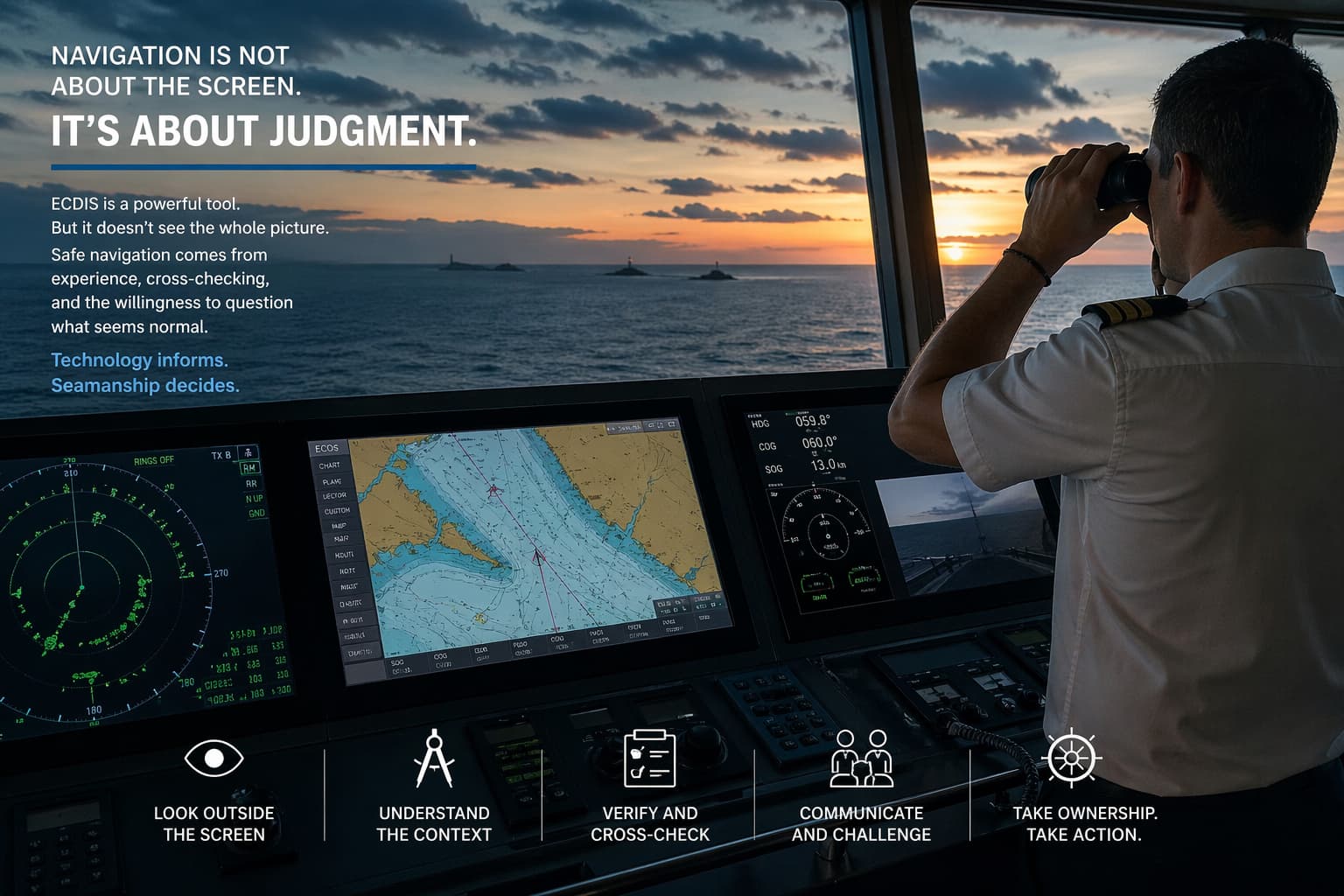
Modern navigation has never been more advanced. With the widespread adoption of Electronic Chart Display and Information Systems (ECDIS), real-time positioning, and integrated bridge systems, vessels today operate with a level of situational awareness unimaginable two decades ago.
And yet, incidents continue.
Groundings in well-charted waters. Near misses in Traffic Separation Schemes. Unsafe approaches under pilotage.
The question is not whether the tools are sufficient. The question is whether their use reflects true navigational control — or a false sense of security.
From an OMRA perspective, this gap is where operational risk transforms into legal exposure.
The Illusion of Precision
ECDIS provides accuracy — but not judgment.
A vessel may appear "safely within limits" on screen while:
- UKC margins are critically reduced due to squat or density variation
- Cross Track Error (XTE) is technically acceptable but operationally unsafe
- Parallel indexing is not properly set or monitored
- Safety contours are incorrectly configured or misunderstood
In multiple investigations, the root cause was not equipment failure — but over-reliance on digital confirmation without independent verification.
The bridge team "trusted the system." But the system was never designed to replace seamanship.
Where the Breakdown Begins
From real case reviews and onboard audits, recurring patterns emerge:
1. Passive Monitoring Instead of Active Navigation
Officers observe the vessel's track rather than controlling it. Course alterations become reactive instead of planned.
2. Generic Passage Planning
Waypoints are entered. Distances calculated. But critical elements are missing:
- No-go areas not clearly defined
- Wheel-over positions not calculated
- Hazards not operationally described
- "Additional Information" fields filled with copy-paste text
A plan exists — but not a navigational strategy.
3. Loss of Redundancy
Traditional methods — visual bearings, radar plotting, echo sounder monitoring — are either reduced or abandoned.
This eliminates the layered defense system that safe navigation depends on.
4. Bridge Resource Management (BRM) in Form, Not Substance
Procedures are followed. Checklists are completed. But challenge culture is weak.
Junior officers hesitate. Masters assume compliance. The system becomes self-confirming rather than self-correcting.
From Operational Error to Legal Consequence
In a claims environment, the analysis shifts rapidly.
What was initially seen as:
"A minor deviation"
Becomes:
"Failure to exercise due diligence."
From an ADR and expert witness standpoint, the following questions are always central:
- Was the passage plan fit for purpose, or merely compliant on paper?
- Were safety margins calculated and applied, or assumed?
- Did the bridge team actively monitor risk evolution, or only vessel position?
- Were company procedures followed in substance, or only in form?
In many cases, the difference between defensible navigation and negligence lies in these details.
Case Insight (Generalised)
A vessel transiting a confined coastal area remained within its planned XTE limits. ECDIS alarms were not triggered.
However:
- Parallel indexing was not effectively utilised
- The safety contour did not reflect actual UKC requirements
- No-go areas were not clearly marked or monitored
The vessel grounded.
From a technical standpoint, the track appeared acceptable. From an operational standpoint, control was lost.
The conclusion was clear:
"Compliance with system parameters does not equate to safe navigation."
The Master's Responsibility in the Modern Bridge
Technology does not reduce responsibility — it raises the standard of accountability.
The Master's role is no longer only to ensure compliance, but to ensure:
- Navigation is actively controlled, not passively observed
- All available means are used — not only digital ones
- The passage plan is a living document, not a static file
- Bridge officers understand why actions are taken — not just how
Most importantly:
"The Master must ensure that the bridge team navigates the vessel — not the system navigating the team."
OMRA Perspective: Where Risk Becomes Exposure
From an advisory and dispute resolution standpoint, navigation cases rarely fail due to a single error.
They fail due to:
- Layered weaknesses
- Human factor complacency
- Procedural formalism without operational depth
This is where OMRA focuses:
- Translating operational failures into clear technical narratives
- Identifying the gap between expected practice and actual conduct
- Supporting legal teams with real-world command-level insight
Because in the end:
"Navigation is judged not by intention — but by execution."
Conclusion
The industry has invested heavily in technology.
But safety has never depended on technology alone.
It depends on:
- Judgment
- Discipline
- Situational awareness
- And the willingness to question what appears "normal"
ECDIS is a tool. Not a safeguard.
And when that distinction is lost, navigation stops being a process — and becomes a liability.
At OMRA, we believe that:
"True maritime risk is not found in what is visible on the screen — but in what is assumed behind it."
Prepared by Capt. Georgios Giannakouris, ACIArb — Operational Maritime Risk Advisory (OMRA). Independent. Discreet. Technically robust.
Disclaimer: This publication is provided for general information only and reflects high-level professional observations. It does not constitute legal advice, expert evidence, or matter-specific professional opinion, and should not be relied upon without formal instruction, full document review, and case-specific assessment.