Work Permits as Evidence: The Operational Document That May Decide a Maritime Accident Dispute
By Captain Georgios Giannakouris · 14 May 2026 · 5 min read
In maritime operations, a work permit is often misunderstood by persons outside the industry as a simple authorization form.
It is not.
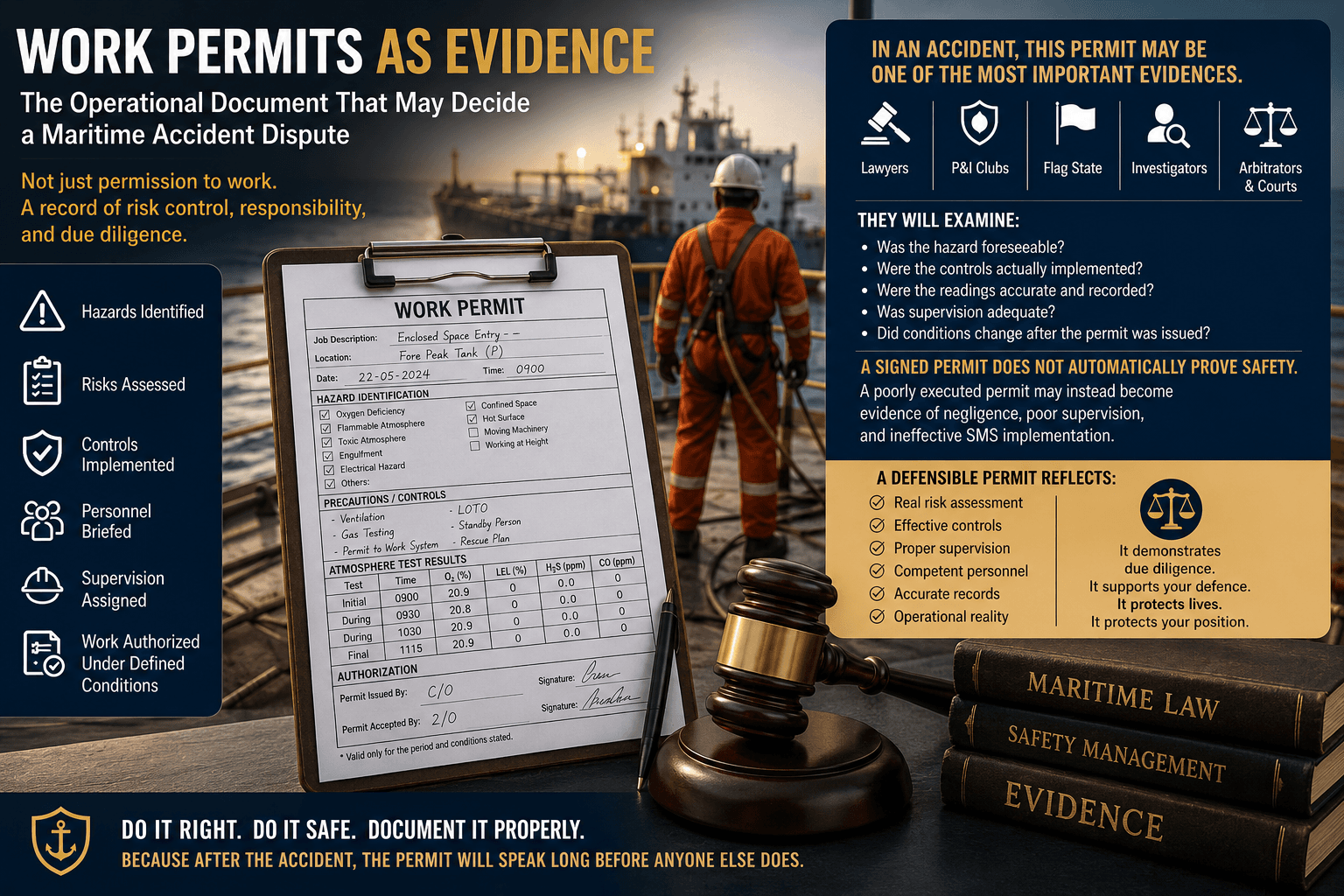
A properly completed work permit is a structured operational decision. It records that a hazardous task was reviewed before execution, that foreseeable risks were identified, that control measures were required, and that responsible persons accepted accountability before the work commenced.
After an accident, that same permit may become one of the most important documents in the entire dispute.
It may be examined by lawyers, P&I Clubs, Flag Administrations, Port State Control, insurers, investigators, arbitrators, courts, and expert witnesses. Its contents may support the defence of the vessel and company. Equally, if poorly completed, it may expose serious weaknesses in supervision, safety culture, and SMS implementation.
A work permit does not merely show that permission was granted. It shows how safety was understood at the time.
The permit as a contemporaneous record
In accident disputes, evidence created before the incident normally carries significant weight.
A permit is not a statement prepared after the event. It is a contemporaneous document. It records what the vessel believed, checked, verified, and authorized before the work started.
This is why its evidential value can be high.
A valid permit may help answer critical questions:
- Was the hazard foreseeable?
- Was the risk assessed?
- Were controls actually implemented?
- Was the atmosphere tested?
- Was the crew briefed?
- Was supervision assigned?
- Were emergency arrangements considered?
- Was the task safe only under specific conditions?
These questions are not theoretical. They often become central issues in maritime claims.
The burden created by signing a permit
A signature on a permit is not decoration.
It is an acceptance of responsibility.
When a Master, Chief Officer, Chief Engineer, Safety Officer, or responsible supervisor signs a permit, that signature may later be interpreted as confirmation that the required checks were completed and that the stated conditions were true.
This creates a burden.
- If the permit states that ventilation was adequate, the evidence must support that.
- If it states that gas testing was completed, the readings must be credible.
- If it states that rescue arrangements were ready, they must have been realistic.
- If it states that personnel were briefed, the briefing must have been meaningful.
If the facts do not match the permit, the permit may become damaging evidence.
The dangerous illusion: "we had a permit"
One of the most serious misunderstandings onboard is the belief that the existence of a permit automatically proves compliance.
It does not.
A permit is defensive only when it reflects reality.
A generic, copied, incomplete, or carelessly signed permit may become evidence of procedural failure. It may show that the company had a system on paper, but not in practice.
In a dispute, the real question is not simply: "Was there a permit?"
The real question is: "Was the permit valid, specific, truthful, properly supported, and operationally implemented?"
That distinction can decide the strength of a defence.
Final OMRA observation
A work permit is not simply permission to work.
It is a record of operational judgment. It is a record of risk ownership. It is a record of supervision. It is a record of whether the SMS was alive or merely printed.
In maritime disputes, the work permit may become the document that explains the difference between an unavoidable accident and a preventable failure.
When properly completed, it protects people and strengthens the legal position. When poorly completed, it may become the first exhibit against the vessel.
At OMRA, we review operational records not as paperwork, but as evidence. Because in maritime disputes, the truth is often found in the documents created before anyone knew there would be a claim.